Most popular posts right now

Showing posts with label Antarctica. Show all posts

22 May 2025

Diverging Findings in Antarctic Ice Sheet Research

Stokes and his colleagues have published a study indicating that by the end of the century, sea levels could rise by as much as a centimeter per year due to the melting of the Greenland and Antarctic ice sheets. This would happen even in the case where humanity manages to limit global warming to 1.5°C. Such a development would mean sea level rise of several meters over the coming centuries.

As a result, people living in coastal areas would need to be relocated, and buildings and other infrastructure built along the coasts would end up submerged. According to the study, a massive transformation lies ahead globally.

This study caught my attention, of course, for the reasons I briefly mentioned above. But also because Chinese researchers Wang, Shen and others have observed that between 2021 and 2023, the melting of the Antarctic seems to have turned into a net gain in ice mass.

This suggests that the results of different researchers are in some degree of contradiction. That, of course, is not unusual—let alone unique—in the scientific world, but it does offer an interesting topic to follow in the coming years.

It could be, of course, that the future projections made by Stokes and his colleagues based on a synthesis approach contain errors—or alternatively, that the increase in Antarctic ice mass observed by Wang and Shen is merely a temporary anomaly within the broader process of ice loss.

Time will tell—if not for us, then for future generations—whether we are facing a catastrophe for the world’s coastal cities or whether the effects of greenhouse gas emissions turn out to be less severe than current research suggests.

For those reflecting on the matter, a reasonable suggestion would be to monitor the changes in Antarctic temperatures over time. For example, according to data from the Vostok Station, located in the interior of the continent and operational since 1958, the warmest years there have been 2007 and 1980. The average temperature in 2007 was -52.60°C, and in 1980 it was -53.02°C.

At those temperatures, ice is unlikely to melt at Vostok—but things are different along the coast. For instance, at Casey Station, which has been operational since 1957, the highest annual average temperature on record was measured in 1980, at -6.55°C. That’s not warm enough to melt ice either, but during the summer months—December and January—average temperatures at Casey rose above freezing.

21 September 2024

Ice Sheet Losses in Antarctica and Greenland

CNN reported that the rapid ice loss of the Thwaites Glacier is set to speed up this century. The retreat of this glacier has accelerated considerably over the past 30 years. Even worse, according to the article, scientists project that Thwaites and the Antarctic Ice Sheet could collapse within 200 years, which would have devastating consequences.

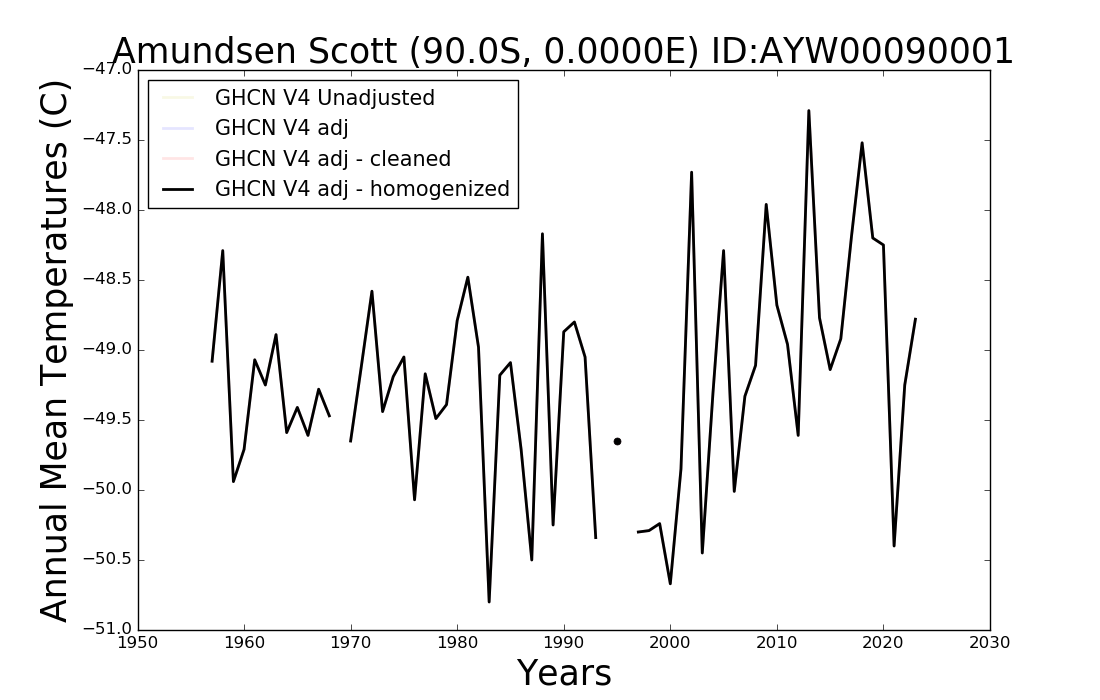
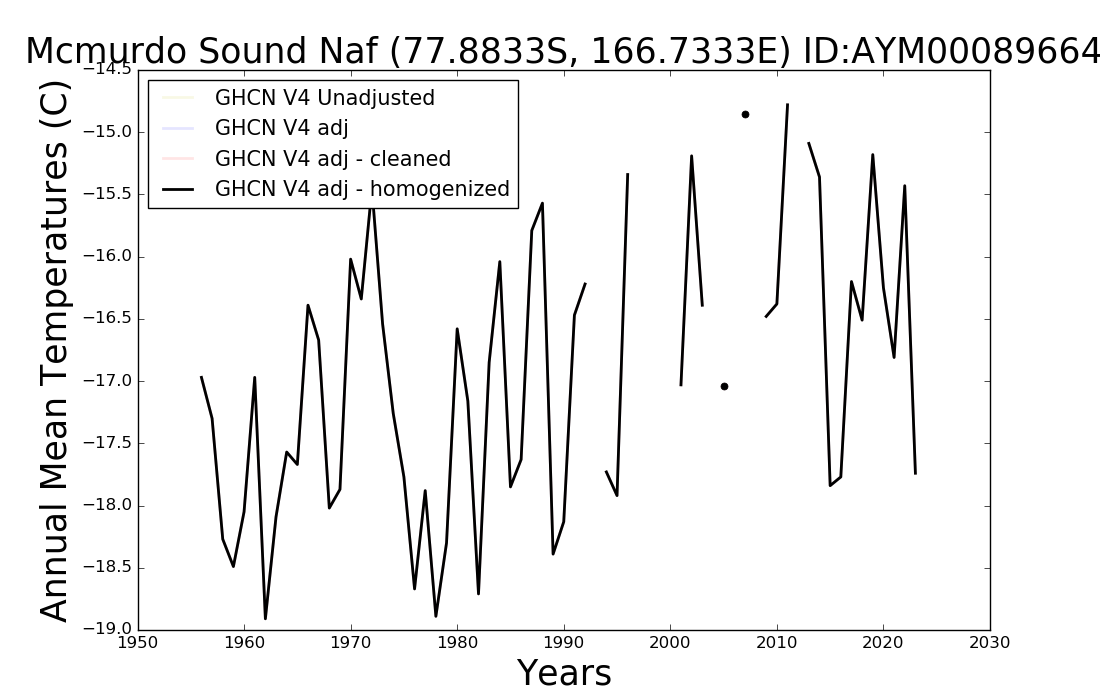
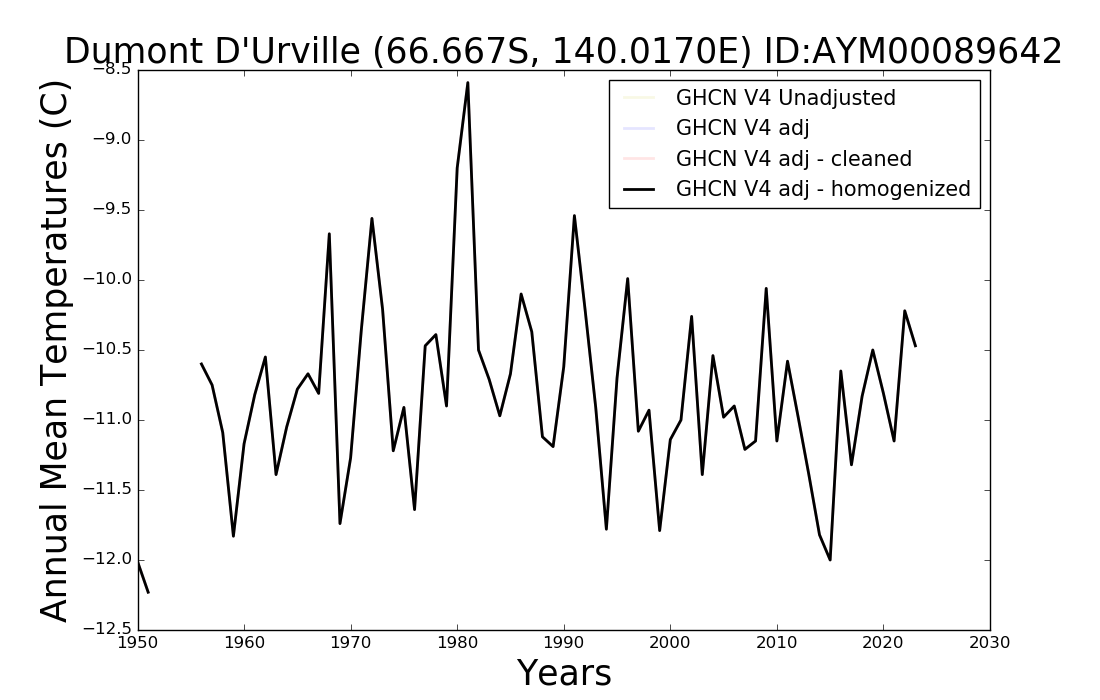
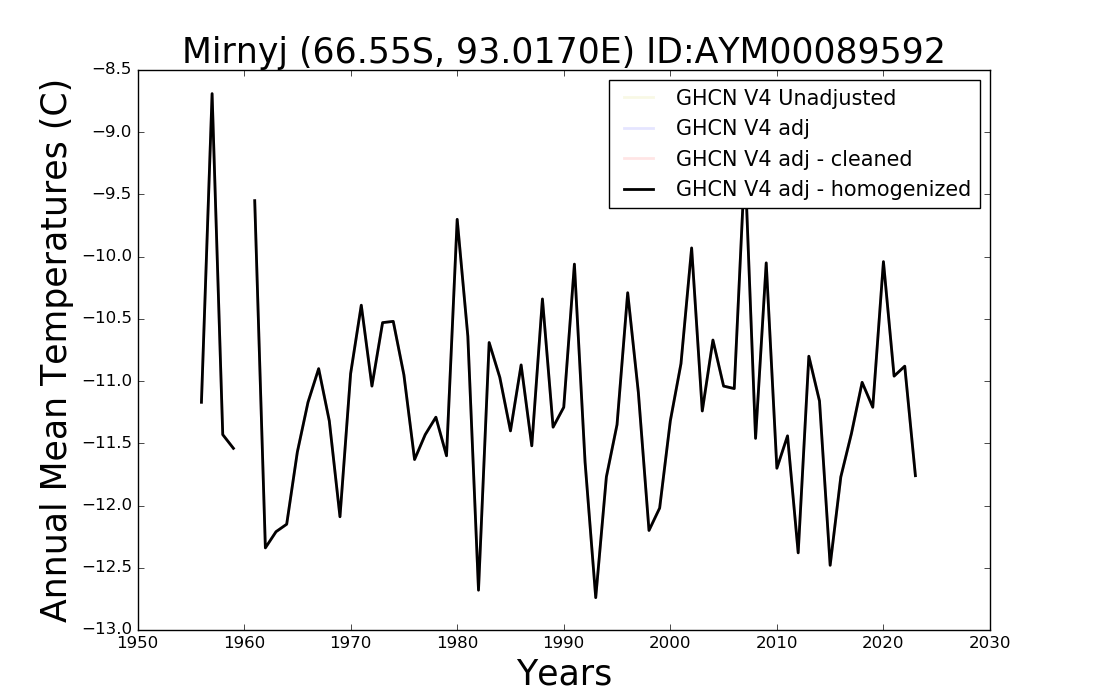
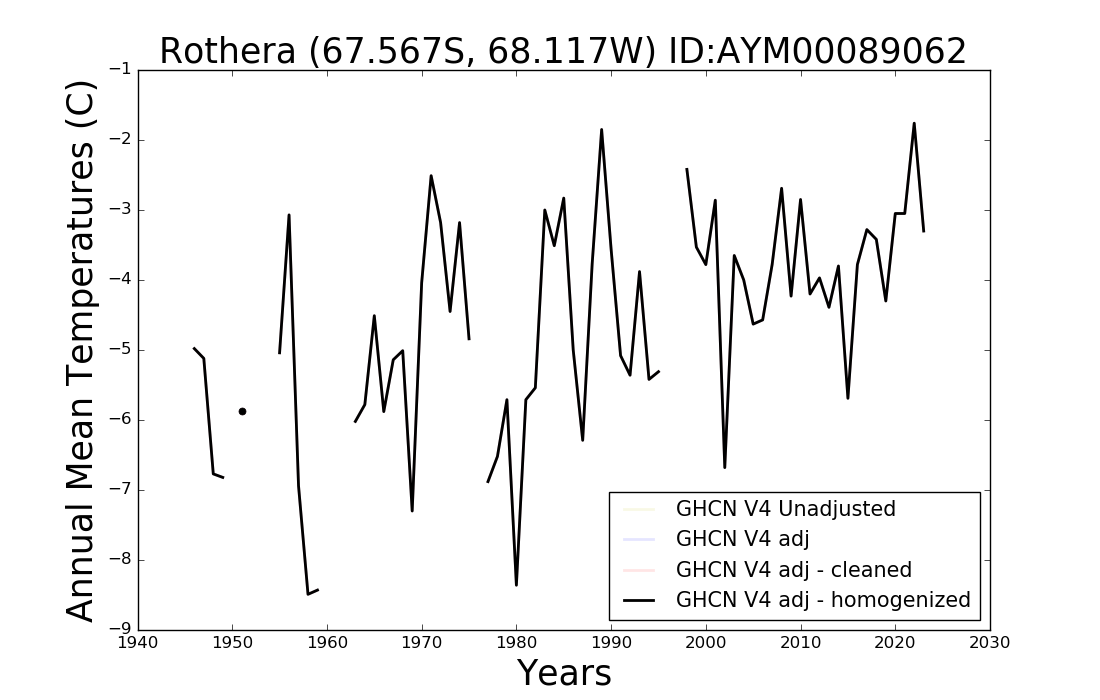
Such a development would, of course, be extremely concerning, and that’s why I decided to look into how temperatures in Antarctica have evolved. For that, I searched NASA's Goddard Institute for Space Studies website for all available time series of Antarctic temperatures that began before the 1960s.

I’ve copied the graphs I found below, starting with Vostok and Amundsen-Scott, located in the central part of the continent, followed by the stations on the continent’s edge, beginning from the boundary of the eastern and western hemispheres and moving westward (like the sun).


My dear reader can draw their own conclusions from the series of images I have copied above. As for me, I do not plan on losing sleep over the CNN article that inspired this writing.

* * *

Speaking of glaciers: it occurred to me that I had read a study by Rebecca Adam McPherson and colleagues, who work in Germany, suggesting that the melting of Greenland’s 79 North glacier, which flows into the ocean, has slowed somewhat in recent years.

While investigating this phenomenon, the researchers found that the water temperatures beneath the glacier’s ice shelf cooled between 2018 and 2021. According to the researchers, this was due to a slowdown in the North Atlantic circulation and the cooling of Atlantic intermediate waters.

This, in turn, was the result of a phenomenon observed in Europe’s atmosphere, where cold Arctic air flowed south through the Fram Strait. This phenomenon is by no means new to science; it has caused other ocean cooling events over the past half-century and will continue to be a key factor in the development of glaciers in northeastern Greenland.

As I read the study, it naturally occurred to me whether this same phenomenon could also explain why Arctic sea ice has not melted since 2013. If so, the melting of sea ice should resume sooner rather than later.

31 May 2024

The amazing adventures of the German cockroach

The German cockroach, also known as the common cockroach, is a member of the animal kingdom that brings to mind positive thoughts for few people - hardly even the most enthusiastic animal rights advocates. However, in all its repulsiveness, it is an extremely interesting creature that is entirely dependent on humans, as it is not known to live independently anywhere in the world.

The German cockroach was described by Carl von Linné, who developed the modern system of organism classification. He also suggested that it originated from somewhere else than Europe. And indeed, he was a wise man, for research has shown that the cockroach originated in Asia and has even traced its spread around the world.

By analyzing mitochondrial genes, it has been shown that the German cockroach is most closely related to the Asian cockroach, which was originally described in Japan but has since spread to the United States. The journey of the German cockroach from Asia has been investigated by mapping genomic similarities from 281 samples collected in 17 countries.

Their genetic relationships indicate that German cockroaches achieved global distribution in two waves, both assisted by humans. However, this only began after the ancestors of the German cockroach diverged from the Asian cockroach about 2100 years ago.

This likely happened in India or Myanmar as the cockroaches adapted to eating human food. After mastering this skill, the German cockroach moved to the Middle East about 1200 years ago, coinciding with the expansion of trade and warfare during the two Islamic caliphates, the Umayyads and the Abbasids. The likely means of transportation were bread baskets carried by people.

In the next wave, the species' range expanded to Southeast Asia about 390 years ago, driven by colonial trade by the Dutch and British East India Companies. Finally, trading ships brought the cockroaches to Europe around 300 years ago.

Subsequently, steamships and improved housing – with heating and plumbing creating warm, humid conditions favored by cockroaches – enabled the German cockroach to spread worldwide. The only place left unconquered is Antarctica.

The story of the German cockroach, as briefly described above, illustrates how natural selection takes advantage of opportunities. First, the abundance of food produced by agriculture created a new ecological niche, allowing some cockroaches to specialize in consuming human food.

With the services provided by humans, the cockroaches were then ready to travel with them all over the world. And to adapt to living in the most diverse conditions – as long as there is someone there providing them with bread and warmth.

Previous thoughts on the same topic:
Traditional beliefs turned out to be wisdom
Leaders infected by a parasite
World oceans are filled with previously unknown viruses