Most popular posts right now

Showing posts with label temperature. Show all posts

14 October 2025

Are Coral Reefs Doomed Within the Next Few Years?

A recent science news report stated that, according to a study signed by 160 researchers, the destruction of coral reefs is now almost certainly irreversible. The report says that most coral reefs will die once global warming exceeds 1.5 degrees Celsius compared to pre-industrial levels.

At present, the climate has warmed by 1.4 degrees, according to scientists, which means that the temperature leading to the irreversible collapse of reefs is expected to be reached within the next few years. When that happens, for example, the ice sheets of Greenland and West Antarctica are likely to collapse.

And that’s not all — according to the lead author of the report, Tim Lenton, one of the tipping points involves the collapse of existing ocean currents, which would have catastrophic consequences. If this were to occur in the ocean circulation system known as the Atlantic Meridional Overturning Circulation (AMOC), it would disrupt the global climate and, among other effects, cool the winters of Finland and the rest of Europe.

* * *

I wanted to highlight this topic because the report provides a clear prediction — one that will be fascinating, if admittedly frightening, to follow in the coming years. It’s especially intriguing because the timeframe mentioned is “in the next few years,” which to my ears sounds more like less than ten years rather than more. At the very least, it doesn’t imply waiting several decades, as shown by the chart published a couple of years ago by the University of Berkeley, which I’ve copied below.


So, I’ll try to remember to follow this issue in the coming years — and to report on it here in this blog, unless I become too senile before the coral reef catastrophe actually happens.

* * *

Before that, however, it’s worth recalling a study from last year which found that coral reef restoration can accelerate the recovery of coral cover and carbonate production so rapidly that the reefs’ net carbonate budgets resemble those of healthy reefs within just four years. And this occurs under the current climate, which is already 1.4 degrees warmer than in pre-industrial times.

And that’s not all — this year another study was published showing that there are also coral reefs that are recovering. At least some can be found in the Chagos Archipelago, where coral cover on both the fore-reef and the lagoon increased by 59–67% after several years of bleaching.

It remains to be seen, however, whether this change of direction is only temporary — or whether it will prove to be permanent.

Previous thoughts on the same topic:
Climate Warning Signs Were There 130 Years Ago – If Only We Had Noticed
Diverging Findings in Antarctic Ice Sheet Research
Big Deal in the Cold North: Finland vs. Canada

The original blogpost in Finnish:
Tuhoutuvatko koralliriutat lähivuosina?

7 October 2025

When Ukraine’s Drones Fly 2,000 km, Putin’s Confidence Shakes

According to the Kyiv Post, Ukraine has carried out a drone strike more than 2,000 kilometers beyond its border. The target was an oil refinery in Tyumen, Russia, which was reportedly damaged in the attack.

Regardless of the extent of the damage, the incident is significant in that it demonstrates that Russian infrastructure is increasingly within Ukraine’s reach. Consequently, Russia’s war economy is becoming ever more vulnerable — just as Vladimir Putin turns 73.

For example, fuel shortages in many regions of Russia are already severe and are making civilian life difficult. One can only imagine how the situation will unfold in the coming months, with homes left unheated as temperatures drop to –20 or even –30 degrees Celsius.

For this reason, there now appears to be considerable potential in the air for an uprising to ignite. And this seems enough for Putin to be paying very close attention to his own security.

This is underlined by reports that even Vyacheslav Leontyev, the 87-year-old former publisher of Pravda, the leading newspaper of the Soviet Union, is said to have fallen from the window of his fifth-floor apartment in western Moscow. The man is believed to have been well informed about the secret wealth of Russia’s elite — undoubtedly including Putin himself — the existence of which is unlikely to provide much comfort to ordinary Russians facing the coming winter’s cold.

7 August 2025

Exceptionally Warm July Falls Short of Records

This past July was the third warmest on record globally. According to the Copernicus Climate Service, the global average temperature in July was 16.68 degrees Celsius. That is 0.45 degrees higher than the July average for the years 1991–2020, and 1.25 degrees higher than during the pre-industrial period.

In Europe, July was the fourth warmest on record, with an average temperature of 21.12 degrees—1.3 degrees above the reference period.

In Finland, however, no temperature records were approached, as for example, Helsinki’s warmest July on record still remains clearly in 2010, with a 1.2-degree margin. In Northern Finland, Sodankylä experienced its warmest July in 2018.

Finland, however, saw the second longest heatwave in recorded history, with temperatures exceeding 25 degrees Celsius for 26 consecutive days at several weather stations. However, the record remains unbroken: in 2021, a station in Southeastern Finland recorded a heatwave lasting 31 days.

According to these statistics, the average July area of Arctic sea ice was also relatively small—the sixth smallest since records began in 1979. This fits the broader pattern observed since around 2007, where the area of Arctic sea ice collapsed and has since settled into a new, lower range of variability.

3 May 2025

Big Deal in the Cold North: Finland vs. Canada

The past winter was exceptionally warm in Northern Europe – according to a recent study, it was even the warmest in at least 2,000 years. That’s why it is interesting that in April, the extent of Arctic sea ice was only the ninth smallest in recorded history (see figure).


This was the case despite the fact that in March, the sea ice area in the north was the smallest since satellite records began in 1979, and April was also warmer than usual in Finland. It remains to be seen whether the Arctic Ocean will melt enough by autumn for the sea routes passing through it to gain renewed attention.

This is also tied to the fact that Finnish and Canadian shipbuilders are competing to sell icebreakers to the United States. In this respect, the Finns have a clear advantage, as only Finland currently has the capacity to build the 40 icebreakers that the U.S. needs – which may be the reason why Canada has offered the U.S. the possibility of building Canadian-designed icebreakers on U.S. soil.

However, in this context, one might imagine that the U.S. would take note of the fact that even the Canadians have just ordered an icebreaker from Finland. And so, to play it safe, they might place their order with Finland as well.

On the other hand, it is clear that 40 icebreakers cannot be built in a year or two, and for that reason, the Americans might well split the order between the competing parties. It remains to be seen how this competition will play out – or whether the entire Arctic will melt to the point that, in three years' time, there will be little to no need for icebreakers in the Arctic Ocean at all.

2 November 2024

Northern Sea Ice Area Has Not Responded to Exceptionally High Temperatures

The past October was extremely hot in many places (one, two, three examples), and for that reason, I checked NASA's NSIDC website to see if the northern sea ice might also have started melting. However, this was not the case; rather, it was the fifth largest in recorded history, as shown in the image below, which presents the polar ice area for each October over the years.


The October area of the northern sea ice was at its smallest in 2020, followed in order by 2007, 2016, and 2019. After these years comes the current year, 2024.

Thus, the area of northern sea ice has not responded to the exceptionally high temperatures on Earth’s surface—or, alternatively, there may be inaccuracies in the measurements of either the surface temperature or the ice area. Time will eventually reveal which explanation is correct.

In any case, throughout 2024, the northern sea ice area has not been the smallest on record for any month. In January, it ranked as the 24th smallest, in February the 14th smallest, in March the 25th smallest, in April the 27th smallest, in May the 24th smallest, and even in June it was the 11th smallest. After that, the melting rate of the ice accelerated compared to other years, and in July its area was the 5th smallest on record, in August the 2nd smallest, in September the 4th smallest, and in October the 5th smallest.

I won’t attempt to predict the coming months. Instead, I would like to point out to you - my esteemed readers - that the image above, which I generated based on NSIDC data seems to suggest that the melting of the ice, which began in the early 1990s, may have stabilized around 2007 and is now oscillating around a new equilibrium or is decreasing noticeably more slowly than in previous years.

I wrote earlier this year about a similar phenomenon in the July statistics, and indeed, it is also evident in the statistics for all other months. So, it remains to be seen how the ice area will develop over the last three months of this year.

21 September 2024

Ice Sheet Losses in Antarctica and Greenland

CNN reported that the rapid ice loss of the Thwaites Glacier is set to speed up this century. The retreat of this glacier has accelerated considerably over the past 30 years. Even worse, according to the article, scientists project that Thwaites and the Antarctic Ice Sheet could collapse within 200 years, which would have devastating consequences.

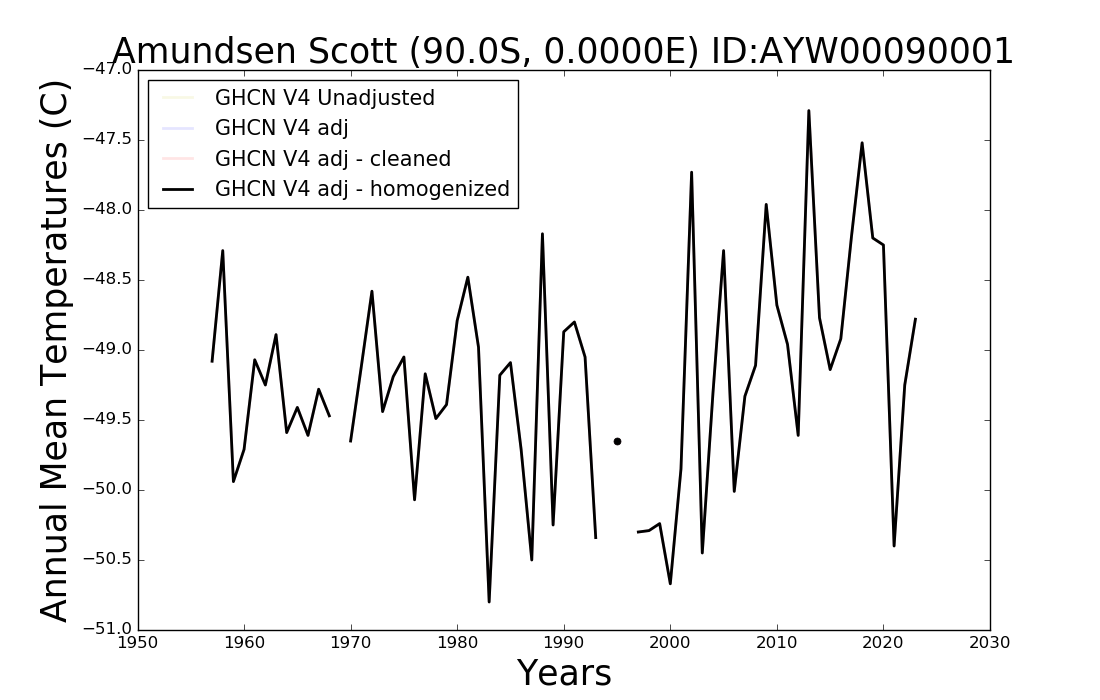
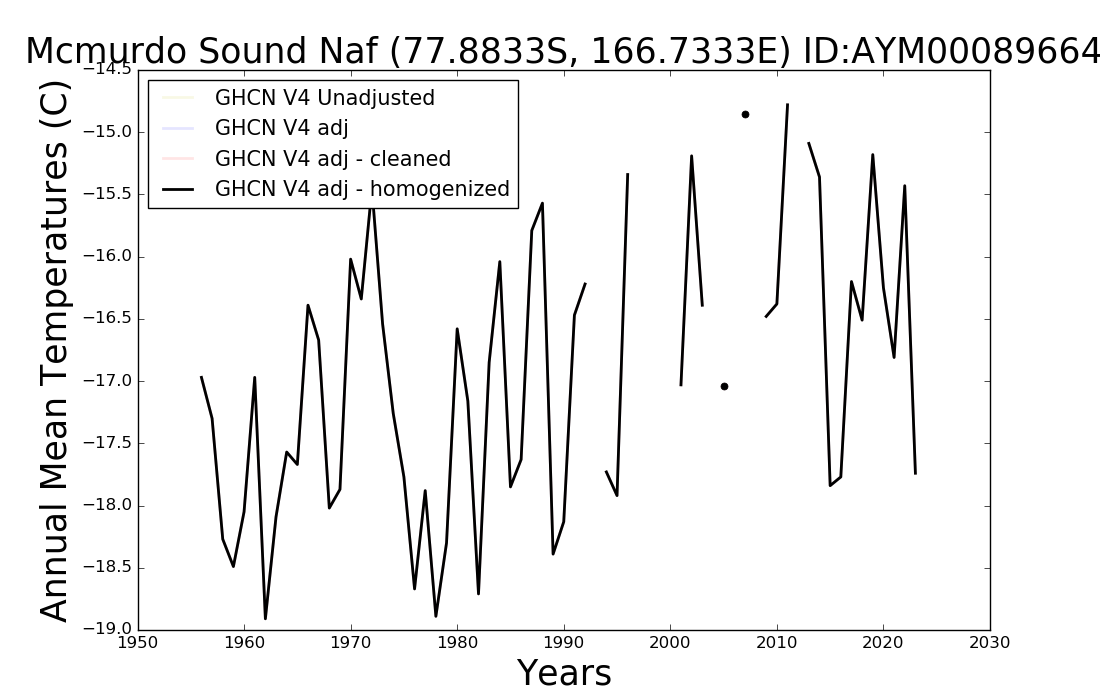
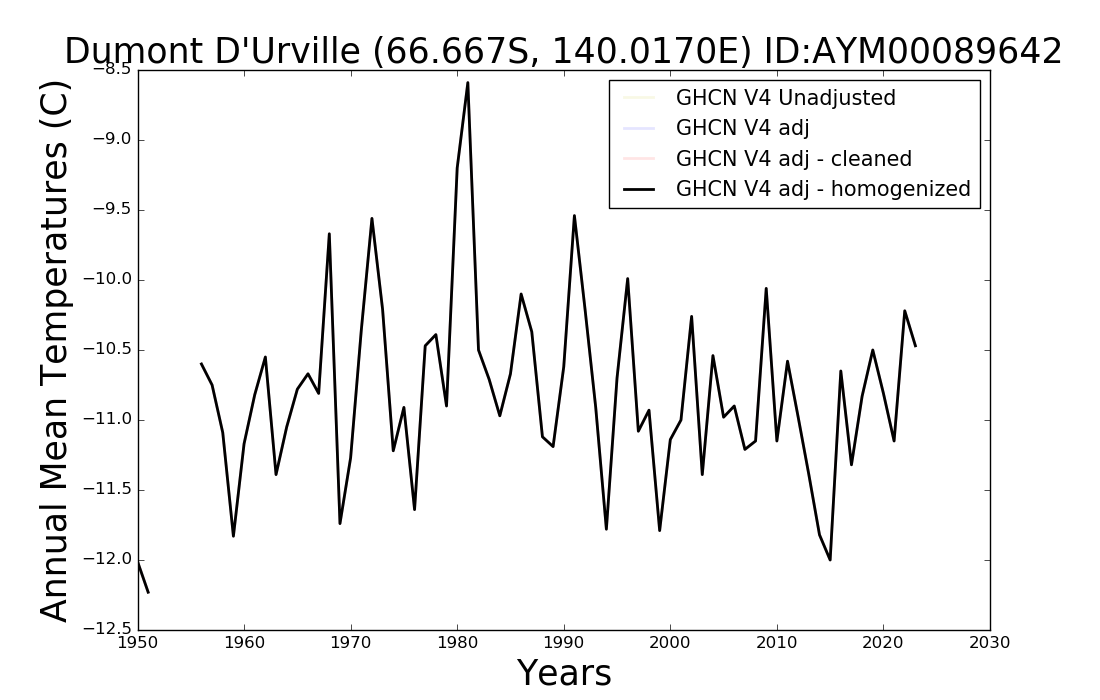
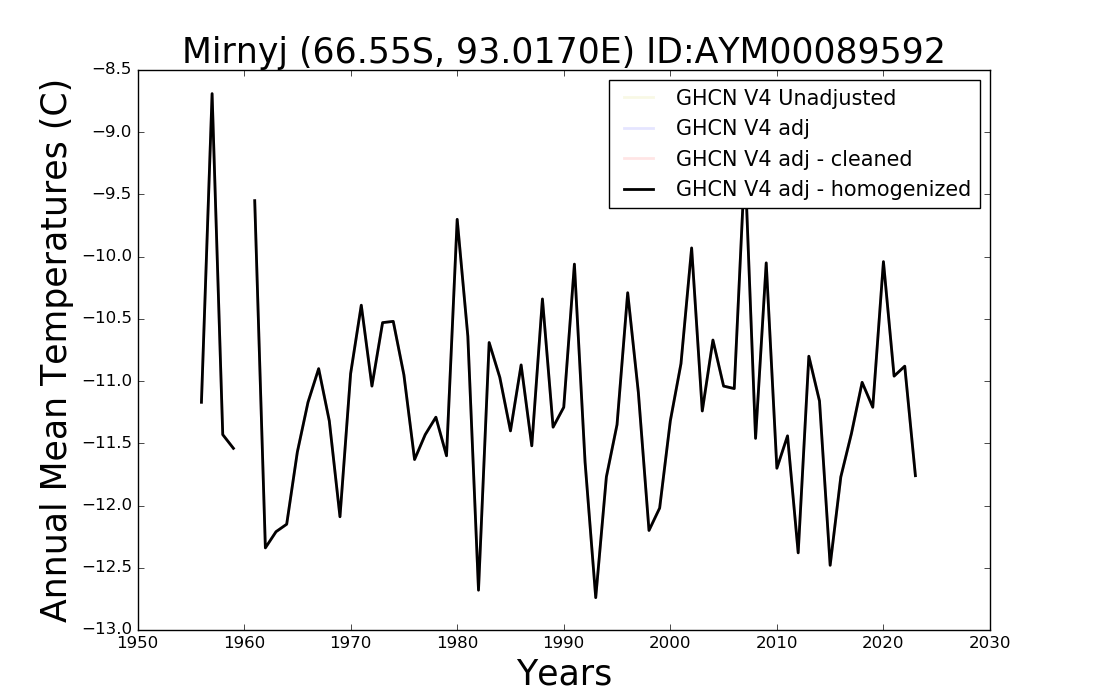
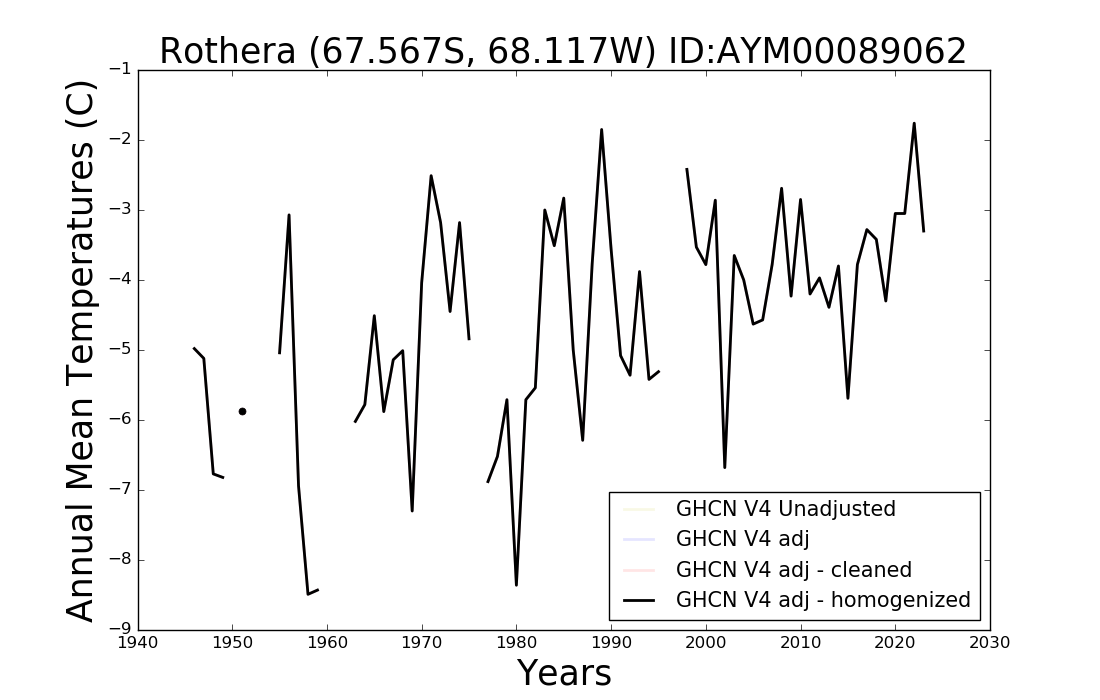
Such a development would, of course, be extremely concerning, and that’s why I decided to look into how temperatures in Antarctica have evolved. For that, I searched NASA's Goddard Institute for Space Studies website for all available time series of Antarctic temperatures that began before the 1960s.

I’ve copied the graphs I found below, starting with Vostok and Amundsen-Scott, located in the central part of the continent, followed by the stations on the continent’s edge, beginning from the boundary of the eastern and western hemispheres and moving westward (like the sun).


My dear reader can draw their own conclusions from the series of images I have copied above. As for me, I do not plan on losing sleep over the CNN article that inspired this writing.

* * *

Speaking of glaciers: it occurred to me that I had read a study by Rebecca Adam McPherson and colleagues, who work in Germany, suggesting that the melting of Greenland’s 79 North glacier, which flows into the ocean, has slowed somewhat in recent years.

While investigating this phenomenon, the researchers found that the water temperatures beneath the glacier’s ice shelf cooled between 2018 and 2021. According to the researchers, this was due to a slowdown in the North Atlantic circulation and the cooling of Atlantic intermediate waters.

This, in turn, was the result of a phenomenon observed in Europe’s atmosphere, where cold Arctic air flowed south through the Fram Strait. This phenomenon is by no means new to science; it has caused other ocean cooling events over the past half-century and will continue to be a key factor in the development of glaciers in northeastern Greenland.

As I read the study, it naturally occurred to me whether this same phenomenon could also explain why Arctic sea ice has not melted since 2013. If so, the melting of sea ice should resume sooner rather than later.

11 June 2024

Can climate models predict the distribution of warming?

According to climate models, greenhouse gases warm the Arctic region faster than the rest of the world, although there is some discrepancy between their predictions and actual measurements. Therefore, it has been more than interesting to follow the development of the northern sea ice over the years.

The National Snow & Ice Data Center (NSIDC) publishes two statistics on its development: the extent of the ice and its area. Of these, daily data is available for the extent, but only monthly averages for the area.

Now that India has suffered from an unprecedented heatwave and southern Europe has also been reported as one of the areas experiencing the most exceptional temperatures, it has been interesting to note that the latest data on the extent of the northern ice shows it is the 37th largest, or 10th smallest, for this time of year in the measurement history starting from 1979.

The monthly area statistic of the northern polar ice surprises even more, as in May, the ice area was the 23rd largest, or 24th smallest, in the statistics, thus roughly at the median value of the statistics. Therefore, the area of Arctic sea ice does not support the idea that the climate is warming fastest in the Arctic region. And even the estimate based on ice extent supports that only weakly.

All this raises questions about the ability of climate models to predict the distribution of warming caused by greenhouse gases across different parts of the globe. Or alternatively, about the reliability of climate statistics: in this regard, the measurements of the Arctic ice cover, carried out with easily interpretable methods, are surely among the most reliable, even though the two different measurement methods of the NSIDC produce surprisingly divergent views of the size of the northern polar ice cover.

7 February 2024

The area of Arctic sea ice was exceptionally large in January

According to climate models, the world is warming frighteningly fast. And even faster in the Arctic sea ice area, which, according to a fairly recent study, entered a state in 2007 from which its surface area cannot recover through normal climate variability.

Recently, it has also been reported that the temperature of the Earth's oceans during the past El Niño year has been the highest in recorded history. As well as the average global climate temperature.

Based on these premises, one could assume that the current January area of Arctic sea ice would be exceptionally small, and its maximum size this winter would be smaller than ever before in recorded history. Or actually, this assumption could be considered a hypothesis derived from the prevailing climate theory nowadays.

So, I went to check the statistics maintained by the National Snow & Ice Data Center on January sea ice areas. Looking at this data series that started in 1979, I was amazed and decided to list the information it contains in the table below.


From the table, it can be seen that the January sea ice area in the Arctic was the 21st largest in its 46-year (the table only includes 45 years due to missing data for the year 1988) observational history. This is clearly larger than the median value of the dataset. Additionally, we notice that the situation was very similar two years ago in 2022, when the ice extent was even larger than this past January.

Therefore, it is interesting to follow how the northern sea ice will develop by the end of this year's autumn. By then, its area should reach its minimum size and perhaps even melt to a smaller area than in 2012, when it was historically at its lowest

1 June 2023

Record low temperature in northern Finland

This spring has been relatively warm in Finland, as expected considering the commonly known predictions of a warming climate.

However, it is worth noting that last night in Kilpisjärvi, located in the northernmost region, the temperature reached a record low for the month of June at -7.7 degrees Celsius. This temperature was 0.7 degrees lower than the previous record set in 1962

It's important to note that this observation does not imply that climate change has been canceled. Instead, it perhaps indicates that the extent of warming is not yet very significant. One possible explanation could be that global temperatures have decreased since 2016, as indicated by satellite data.

The satellite data also aligns with measurements of the arctic sea extent, which currently show a considerable increase compared to the same time in 2012, 2016, and many other years. This hiatus has been attributed to the prolonged La Niña period and the absence of El Niño since 2016.

However, it appears that the long-awaited El Niño may be starting, which makes it extremely interesting to see whether the temperature records from the last decade will be surpassed both globally and locally in the Arctic region. Could it even be possible that next year's summer will set a new temperature record in Kilpisjärvi?