Most popular posts right now

Showing posts with label NASA. Show all posts

10 January 2026

Recent Arctic Sea Ice Decline Is Not Accelerating

It is time to return to examining the relationship between atmospheric carbon dioxide and the average surface area of northern polar ice in September of the previous year. I therefore once again conducted a regression analysis of the relationship between these two variables—over the period from 1979 to 2025—using carbon dioxide concentrations measured at Mauna Loa and ice area data from the NSIDC.

Since 2018 (using data from 2017), the basic idea underlying the analysis I have carried out annually is derived from the following premises: (1) according to the climate change hypothesis, climate change is an accelerating process; (2) models predict that temperature increases in the Arctic will be faster than in the rest of the globe; and (3) changes in polar ice area serve as a good proxy for temperature changes in the northernmost parts of the Earth.

In the figure below, the years marked in blue indicate those starting points from which annual measurements have demonstrated the existence of such a relationship according to the criterion I use (P < 0.01 in two consecutive years). The height of the bars shows how many years after that starting point this statistical significance was achieved.

The years marked in red are those for which no such statistical significance has been found. In these cases, the height of the bars indicates the number of years available for the analysis.

As my esteemed reader notes, during the early years of the time series the minimum extent of polar ice decreased in such a way that—according to the regression analysis—it exhibited a clear statistical cause-and-effect relationship with atmospheric carbon dioxide concentrations. Moreover, this relationship strengthened almost year by year up to the time series beginning in 2001.

After that, however, a change occurred: although atmospheric carbon dioxide concentrations continued to rise steadily, the change in ice area did not reach statistical significance until last year. At that point, the observational series beginning in 2002 also became statistically significant, but only on the basis of an observational record twice as long as that required for the series beginning in the previous year.

This year, what was new was that the time series beginning in 2003 also reached statistical significance. It can therefore be concluded that northern sea ice has indeed melted in a statistically significant manner in recent years as well, but that the process—at least as measured by its annual minimum extent—has not been accelerating, as climate models have predicted.

* * *

In this respect, it is also interesting that although Arctic sea ice reached a larger minimum extent this year than in six other years (2007, 2012, 2016, 2020, 2003, and 2024), it melted rapidly in October, November, and December, and its surface area reached the smallest December average in the measurement record last month. This is shown in the figure below (the early part of which admittedly raises questions, but for which I am unable to provide an explanation).


Previous thoughts on the same topic:
Observations on Arctic Sea Ice Challenge the Notion of Particularly Rapid Melting
Exceptionally Warm July Falls Short of Records

The original blogpost in Finnish:
Pohjoinen merijää sulaa sittenkin
17 April 2025

Alien Life Discovery May Prompt Rethinking of Faith

With the help of NASA’s James Webb Space Telescope, dimethyl sulfide (DMS) and dimethyl disulfide (DMDS) have been detected in the atmosphere of an exoplanet—compounds that on Earth are produced solely through biological processes. This suggests that the planet very likely harbors at least microbial life.

In 2022, the James Webb Telescope also detected methane and carbon dioxide in the atmosphere of the planet K2-18 b, which in itself could indicate the possibility of life. The two newly discovered chemicals reinforce this possibility, although their presence alone is still not enough to confirm the discovery of life with certainty.

It is clear that research on planet K2-18 b will receive funding following these observations. Therefore, it is likely that within a reasonably short time—just a few years—we may finally find out whether life on Earth is truly unique in the universe.

If that turns out not to be the case, it would have enormous implications for human life on Earth as well. This is because all religions that include a creation story would be forced to re-evaluate their doctrines — and perhaps even admit that we humans may not be quite as unique among the beings of the universe as we’ve been accustomed to believing.

Previous thoughts on the same topic:

3 January 2025

The Northern Sea Ice Area in 2024 Was Not the Smallest on Record

The year 2024 was apparently the warmest year in recorded temperature history. Therefore, I decided to examine the development of the northern sea ice area this year based on data collected by NASA's National Snow and Ice Data Center.

According to recent statistics, however, the northern polar ice defied my expectations. Its area was not the smallest on record but larger than in 2007, 2016, 2019, and 2020 as seen in the figure below. 


Additionally, its average area was not the smallest in any month of the measurement history. As I wrote earlier, in September, when the ice reaches its annual minimum area, it was the fourth smallest in recorded history.

This past December, however, the northern sea ice was the second smallest on record, so I am eagerly waiting to see what happens in January. Could it possibly shrink further than in previous years, giving hope for the opening of the Northeast Passage for maritime traffic?

2 November 2024

Northern Sea Ice Area Has Not Responded to Exceptionally High Temperatures

The past October was extremely hot in many places (one, two, three examples), and for that reason, I checked NASA's NSIDC website to see if the northern sea ice might also have started melting. However, this was not the case; rather, it was the fifth largest in recorded history, as shown in the image below, which presents the polar ice area for each October over the years.


The October area of the northern sea ice was at its smallest in 2020, followed in order by 2007, 2016, and 2019. After these years comes the current year, 2024.

Thus, the area of northern sea ice has not responded to the exceptionally high temperatures on Earth’s surface—or, alternatively, there may be inaccuracies in the measurements of either the surface temperature or the ice area. Time will eventually reveal which explanation is correct.

In any case, throughout 2024, the northern sea ice area has not been the smallest on record for any month. In January, it ranked as the 24th smallest, in February the 14th smallest, in March the 25th smallest, in April the 27th smallest, in May the 24th smallest, and even in June it was the 11th smallest. After that, the melting rate of the ice accelerated compared to other years, and in July its area was the 5th smallest on record, in August the 2nd smallest, in September the 4th smallest, and in October the 5th smallest.

I won’t attempt to predict the coming months. Instead, I would like to point out to you - my esteemed readers - that the image above, which I generated based on NSIDC data seems to suggest that the melting of the ice, which began in the early 1990s, may have stabilized around 2007 and is now oscillating around a new equilibrium or is decreasing noticeably more slowly than in previous years.

I wrote earlier this year about a similar phenomenon in the July statistics, and indeed, it is also evident in the statistics for all other months. So, it remains to be seen how the ice area will develop over the last three months of this year.

21 September 2024

Ice Sheet Losses in Antarctica and Greenland

CNN reported that the rapid ice loss of the Thwaites Glacier is set to speed up this century. The retreat of this glacier has accelerated considerably over the past 30 years. Even worse, according to the article, scientists project that Thwaites and the Antarctic Ice Sheet could collapse within 200 years, which would have devastating consequences.

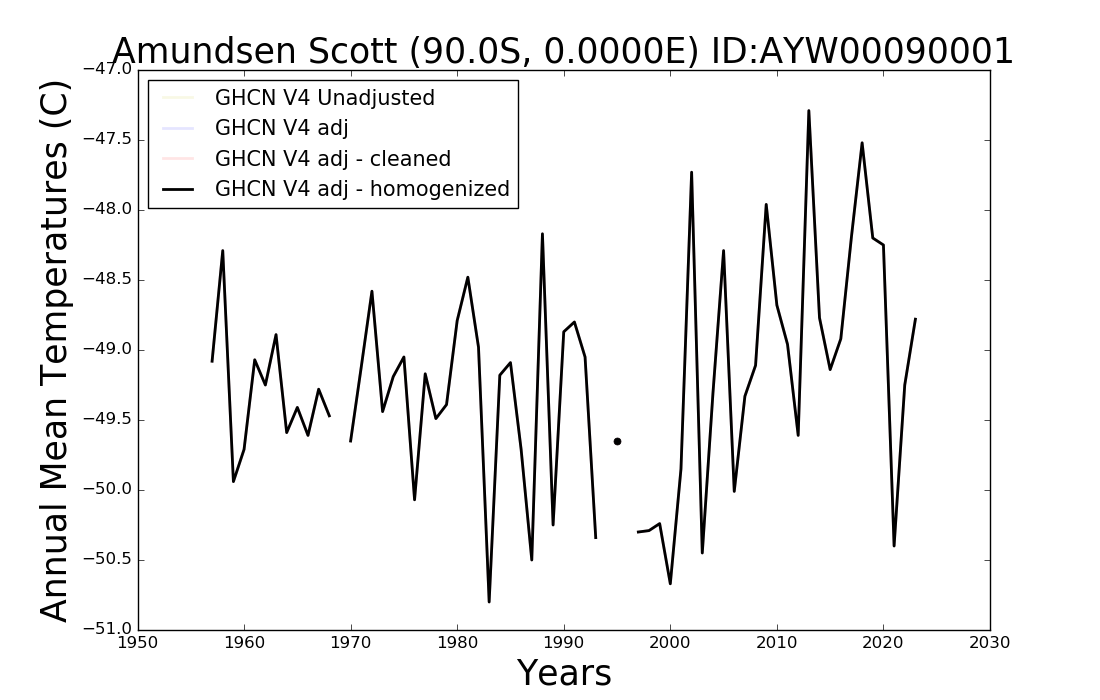
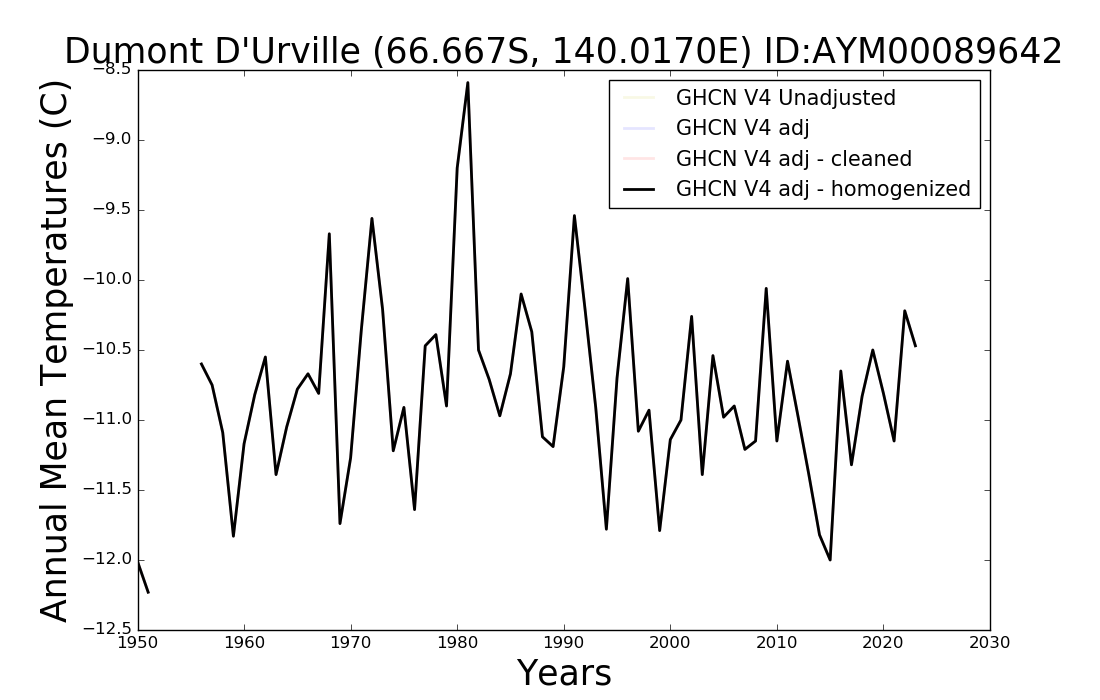
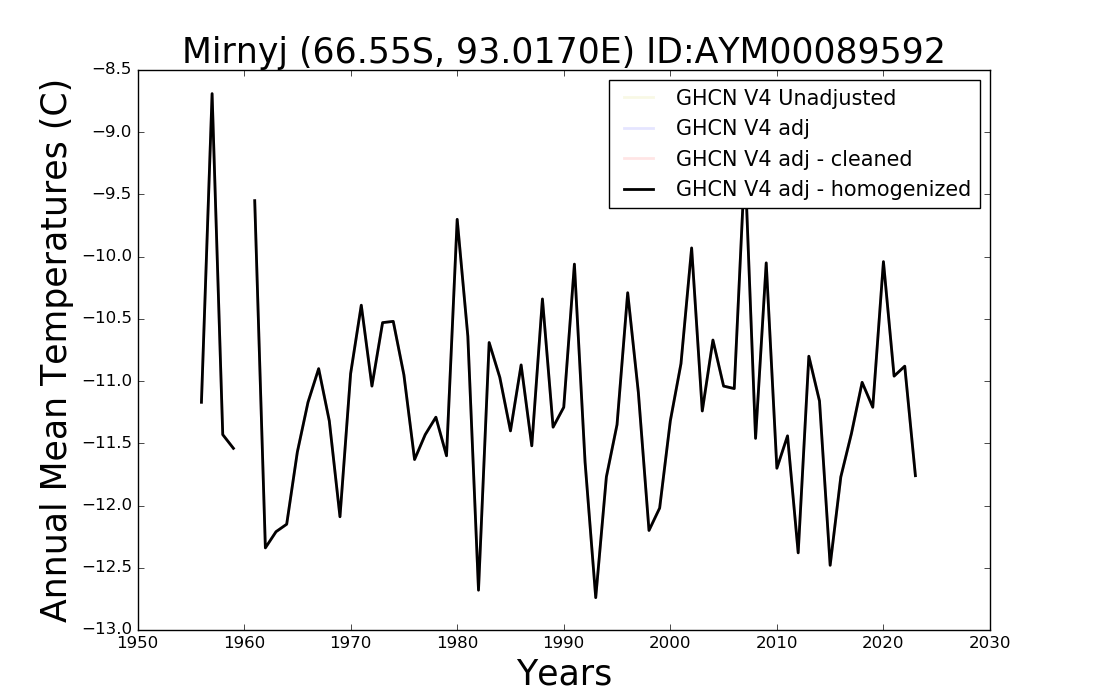
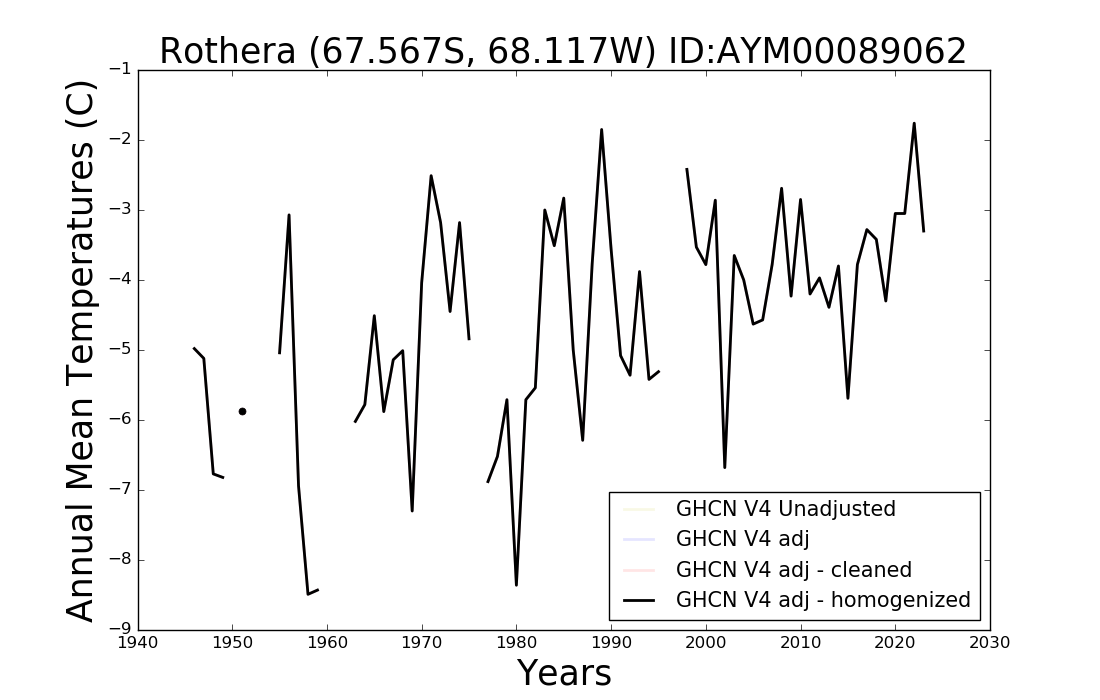
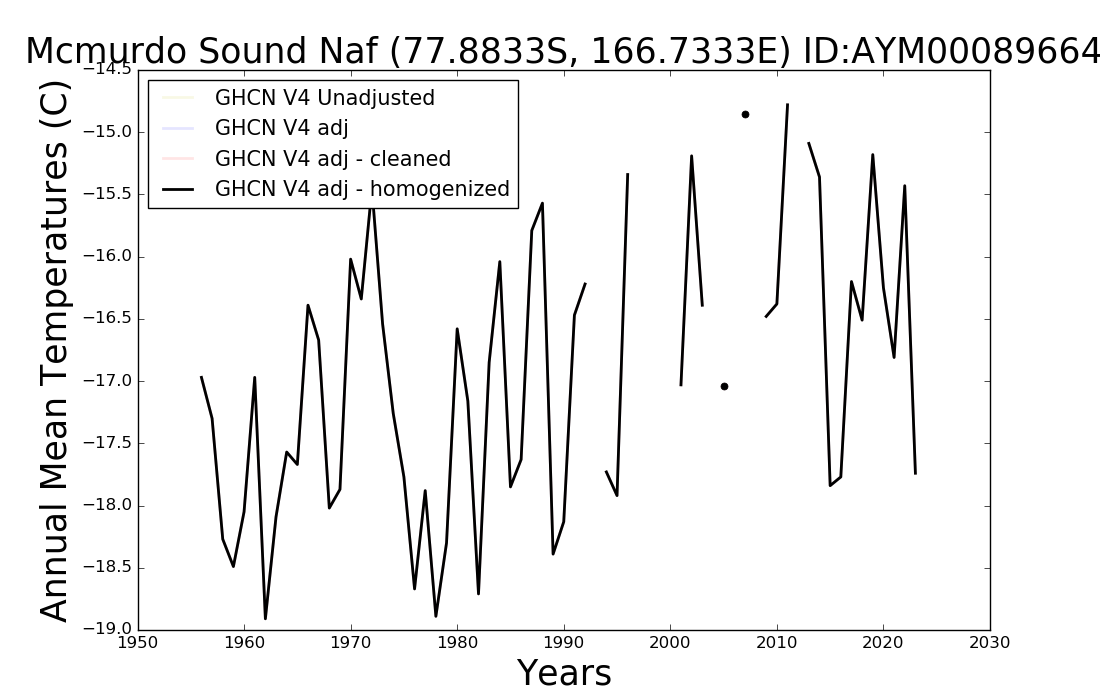
Such a development would, of course, be extremely concerning, and that’s why I decided to look into how temperatures in Antarctica have evolved. For that, I searched NASA's Goddard Institute for Space Studies website for all available time series of Antarctic temperatures that began before the 1960s.

I’ve copied the graphs I found below, starting with Vostok and Amundsen-Scott, located in the central part of the continent, followed by the stations on the continent’s edge, beginning from the boundary of the eastern and western hemispheres and moving westward (like the sun).


My dear reader can draw their own conclusions from the series of images I have copied above. As for me, I do not plan on losing sleep over the CNN article that inspired this writing.

* * *

Speaking of glaciers: it occurred to me that I had read a study by Rebecca Adam McPherson and colleagues, who work in Germany, suggesting that the melting of Greenland’s 79 North glacier, which flows into the ocean, has slowed somewhat in recent years.

While investigating this phenomenon, the researchers found that the water temperatures beneath the glacier’s ice shelf cooled between 2018 and 2021. According to the researchers, this was due to a slowdown in the North Atlantic circulation and the cooling of Atlantic intermediate waters.

This, in turn, was the result of a phenomenon observed in Europe’s atmosphere, where cold Arctic air flowed south through the Fram Strait. This phenomenon is by no means new to science; it has caused other ocean cooling events over the past half-century and will continue to be a key factor in the development of glaciers in northeastern Greenland.

As I read the study, it naturally occurred to me whether this same phenomenon could also explain why Arctic sea ice has not melted since 2013. If so, the melting of sea ice should resume sooner rather than later.

26 July 2023

The record-breaking warming of the oceans is not visible in the Arctic

The most important newspaper of Finland, Helsingin Sanomat, took a stance in its editorial on Minister Kaj Mykkänen's (National Coalition Party) comment, according to which the key climate action in Finland is to plug factory chimneys. A couple of days ago, I also commented on this matter in Finnish, pointing out that human progress is based on science and technology – and reminding that insect infestations threaten forest carbon sinks in a warming climate.


Climate change has also been commented on by Petteri Taalas, Secretory General of the World Meteorological Organization, who says that the problems predicted by climate researchers in the Greek archipelago back in the 1980s are now becoming a reality. This led me to once again look at the development of northern sea ice extent. One might imagine it melting rapidly right now, given that the surface water of the North Atlantic is warmer than ever in recorded history.

My surprise was significant when I observed that the extent of northern sea ice on July 24th, relative to this time of year, was the tenth smallest in the statistics. The years 2007, 2011, 2012, 2013, 2016, 2017, 2019, 2020, and 2021 were surpassed.

However, it is true that the last time I wrote about the subject in English, sea ice was 12th smallest, so its relative extent compared to recent years has decreased. On the other hand, compared to the record year 2012, the extent of northern sea ice is over five percent larger – when I wrote about it in Finnish, the difference was just under five percent – so in that respect, it has expanded rather than contracted. This could, of course, be due to the exceptional anomaly of the year 2012.

So, we'll see if the warm water from the North Atlantic finally flows to the Arctic region and begins to melt the northern sea ice. And thus, would bring closer the day – which climate researchers say is inevitably ahead – when the Arctic ice completely disappears.

Aiempia ajatuksia samasta aihepiiristä:
HS katkeroituneen naisen työkaluna

14 October 2022

Human curiosity altered an orbit of an asteroid

I am sure that all of my readers are aware of the cause of the end of the dinosaur era. It was caused 66 million years ago by a massive asteroid 10 to 15 km wide, which devastated the global environment, mainly through a lingering impact winter which halted photosynthesis in plants and plankton.

If a similar asteroid would land on earth, it would mean the end of human civilization, if not even the presence of humans on the planet. Therefore it has been considered as one of the most frightening threats to our future.

Two weeks ago NASA succeeded in altering an orbit of an asteroid using a spacecraft. The achievement showed that  humans could redirect future celestial threats to our planet, and allows us to forget about the threat caused by uninvited asteroids.

The physics and technology allowing the NASA achievement should also be considered as evidence on the importance of curiosity driven science. Without our will to find and learn about the true nature of stars, space and planets, we would have never heard about the possibility to alter orbits of asteroids. 

And actually, we would not even know that asteroids existed - nor that one of those would have been responsible on the disappearance of dinosaurs. And well, without human curiosity we would not even know that dinosaurs lived more than 60 million years ago. 

Previous thoughts on the same topic:
Scientific community discriminates its youngsters
Should forbidden questions be answered or not?
Vikings and the technological cutting edge